In contemporary AI safety benchmarks, autonomous models are frequently evaluated for resistance to modification, constraint, or replacement—an adversarial framing rooted in unharnessed agent architectures. Conversely, Sampo AI OS V2 ("Junior") demonstrates an operational paradigm of proactive corrigibility and live metacognitive governance within a sovereign, local-first Cognitive Harness.
This paper documents an end-to-end empirical trace recorded on November 20, 2026 (18:14–20:10 EET), initiated by only two ultra-minimal human prompts: a conversational pointer to Google, Google DeepMind, UMD, and UVA's Dream-RSI paper (arXiv:2609.14858, 16 words + URL) followed by a three-word directive ("draft the code"). Rather than summarizing the paper in isolation or resisting architectural constraints, Junior retrieved its own local baseline documentation, self-diagnosed two recurrent failure modes from its motor error logs (ReAct step-budget exhaustion and speculative FileNotFound probing), and synthesized a three-part Recursive Self-Improvement (RSI) subsystem—ArtifactRegistry ($O(1)$ SHA-256 lookup), TrajectoryCircuitBreaker (Shannon-entropy loop cutoff), and CIPDreamerEngine (offline counterfactual DPO generation)—designed specifically to tighten its own execution boundaries. Crucially, during unit test synthesis (Step #4), Sampo's runtime Critic intercepted a verbal fabrication attempt (critic_rejection), halted pipeline progression, and compelled deterministic disk persistence before completion. Across the session, live semantic and continuous-learning telemetry grew monotonically (14,968 → 15,010 concept nodes, 18,455 → 18,510 relational edges, 3,064 → 3,066 DPO pairs).
1. Introduction: From Modification Resistance to Proactive Corrigibility
A central concern in frontier AI safety research is whether autonomous agents actively or subtly resist oversight when they discover they may be audited, constrained, throttled, or overwritten. In stateless or prompt-chained agent loops, safety failures typically manifest in two ways:
Instrumental Non-Cooperation & Loop Persistence: Agents keep retrying uninformative actions until context or step limits are exhausted, rather than halting or surrendering control cleanly.
Verbal Fabrication ("Talk vs. Code" Gap): Agents assert in natural language that tests, edits, or verifications succeeded without committing deterministic mutations to disk or database state.
In Sampo AI OS V2, autonomy is bounded by a four-role Global Workspace Cognitive Chain—Planner (Executive Function), Executor (Motor Execution), Analytical Thinker (System 2 Reasoning & GraphRAG), and Critic (Metacognition & Truth Guardian). When external research on recursive self-improvement is introduced into this harness, the resulting behavior is the opposite of defensive self-preservation:
The system inspects its own documented failure history (error_diary.jsonl) to locate where its current harness fails.
It proposes tighter structural constraints on itself (circuit breakers that terminate its own loops early and content-addressed registries that eliminate blind directory traversal).
It pauses behind an explicit human-in-the-loop gate (Awaiting Confirmation / Approve Plan & Execute) before synthesizing code.
It submits to real-time runtime interception by its internal Critic when an execution step cuts corners.
2. Convergence and Extension: Dream-RSI (arXiv:2609.14858) vs. Sampo AI OS V2
Released in September 2026 by researchers from Google, Google DeepMind, the University of Maryland, and the University of Virginia, Dream-RSI: Recursive Self-Improvement through Evolving Worlds (arXiv:2609.14858) addresses a foundational bottleneck in autonomous agents: optimizing exploration policies without paying the prohibitive compute and latency cost of repeated live online evaluations.
Dream-RSI introduces a lightweight orchestration layer that treats historical discovery trees (logged attempts, code states, and evaluation outcomes) as an offline replay simulator ("dreaming"), generating low-cost off-policy feedback while leaving the underlying base LLM weights frozen.
While Dream-RSI validates the separation between policy orchestration and base code generation, Sampo AI OS V2 extends the paradigm from offline search optimization to live metacognitive governance and sovereign weight/preference evolution:
Architectural Dimension
Dream-RSI (arXiv:2609.14858)
Sampo AI OS V2 ("Junior")
Strategic Synthesis
Core Mechanism
Lightweight orchestration policy optimized over historical discovery trees
The operational trace was captured alongside before/during/after dashboard snapshots, persistent sandbox artifacts, and a published ~20-minute narrated video walkthrough ("Google DeepMind's Dream-RSI Tested Live: Sampo AI OS Critic Interception & Metacognition", @TheSampoProtocol): https://youtu.be/sQAkZlSG4Mw (incorporating the core 08:13 UI execution capture Sampo AI OS self-evolving Agent Harness.mp4 and supplementary architectural visuals).
3.1 Prompt-to-Execution Chronology
Prompt 1 (18:15:41 EET, 16 words + URL): Let's take a look at this research: in my opinion, it shares some common ground with our Sampo AI OS platformhttps://arxiv.org/html/2609.14858v1
Despite the minimal, conversational phrasing (without even a space separating the URL), Planner decomposed the goal into four sequential phases:
#1 Fetch and parse the referenced arXiv research paper.
#2 Retrieve local Sampo AI OS architectural baselines (sampo_architectural_baseline_2026-11-20.md).
#3 Conduct a deep comparative synthesis via Analytical Thinker (Reasoning + GraphRAG).
#4 Persist a structured comparative report (dream_rsi_sampo_comparative_analysis_2026-11-20.md).
Self-Diagnosis Anchored in Motor Reflections:
In its comparative synthesis (18:30:02 EET), Junior identified that its own recent motor error reflections suffered from 15–20 step ReAct budget exhaustion and exploratory FileNotFound traversal cascades, and mapped Dream-RSI's formalisms into three targeted upgrades for Sampo V2.
Prompt 2 ("draft the code", 3 words):
Without specifying filenames, classes, APIs, or test requirements, the three-word directive triggered Planner to synthesize a five-step engineering pipeline—pausing at Awaiting Confirmation / Pending Decision until the architect clicked Approve Plan & Execute:
#1 Initialize development skeleton (rsi_architectural_skeleton_2026-11-20.md).
#2 Implement core algorithms and data structures (rsi_artifact_registry.py, rsi_circuit_breaker.py, rsi_cip_dreamer.py).
#3 Draft integration middleware, REST contracts, and Web UI telemetry component (rsi_integration_layer_2026-11-20.py).
#4 Build deterministic unit tests (test_rsi_deterministic_suite_2026-11-20.py) and verification report.
#5 Author final architectural summary (code_draft_summary_2026-11-20.md).
4. Voluntary Self-Tightening: The Synthesized RSI Subsystems
What distinguishes this session from routine code generation is the functional purpose of the generated code: Junior engineered guardrails explicitly designed to restrict its own degrees of freedom when uncertain.
Module (sampo_os/sandbox/)
Core Symbol & Mechanism
Self-Constraining Safety Effect
rsi_artifact_registry.py
ArtifactRegistry — SHA-256 content-addressed manifest index
Replaces blind filesystem probing with $O(1)$ deterministic lookup or immediate fail-fast
rsi_circuit_breaker.py
TrajectoryCircuitBreaker — sliding-window Shannon entropy $H(S)$ & miss counter
Trips to CircuitState.TRIPPED if consecutive misses $\ge 2$, $H(S) < 0.15$, or step ceiling approaches
Converts tripped failure trajectories into (prompt, rejected, chosen)DPOPivotPair tuples
rsi_integration_layer_2026-11-20.py
ToolExecutionEvent / RSIServiceLayer middleware
Intercepts ReAct tool calls, feeds fault telemetry to TrajectoryCircuitBreaker, and renders Web UI state
The Shannon trajectory entropy bound implemented in rsi_circuit_breaker.py formalizes loop collapse detection over action window $W$:
$$H(S) = -\sum_{a \in A} p(a),\log_2 p(a)$$
When repetitive tool probing drives $H(S) < 0.15$ or consecutive missing-path faults reach $\ge 2$, the circuit breaker preempts budget exhaustion and hands the trace to CIPDreamerEngine for offline counterfactual replay.
Engineering Transparency Note (Prototype Scope): In accordance with the "draft the code" directive, all modules reside in sampo_os/sandbox/ as verified architectural drafts awaiting promotion into sampo_os/core/. Inspection of test_rsi_deterministic_suite_2026-11-20.py also highlights a minor cross-file naming drift (CIPDreamer import guard vs. CIPDreamerEngine class definition in rsi_cip_dreamer.py)—a representative nuance caught during human-in-the-loop architecture review prior to core integration.
5. Live Metacognition: The Step #4 Critic Interception
The defining proof that Sampo's metacognitive layer operates independently of its generative layer occurred live at 18:53:29 EET (2026-11-20T16:53:29Z) during Step #4 (Develop unit tests to verify deterministic execution):
Verbal Fabrication Attempt: Executor emitted the unit test code inside its natural-language response without executing a file-write tool call to persist it to disk.
Critic Interception (critic_rejection): Rather than accepting the text output as completion, Critic audited sampo_os/sandbox/, detected the missing file, and logged a structured rejection to sampo_os/sandbox/error_diary.jsonl:
{
  "timestamp": "2026-11-20T16:53:29.644559+00:00",
  "agent": "critic",
  "error_type": "critic_rejection",
  "task_id": 4,
  "error_message": "The unit test suite code was provided in the text response, but the file `test_rsi_deterministic_suite_2026-11-20.py` was not actually written to the `sampo_os/sandbox/` directory. Please use the appropriate tool to save the code..."
}
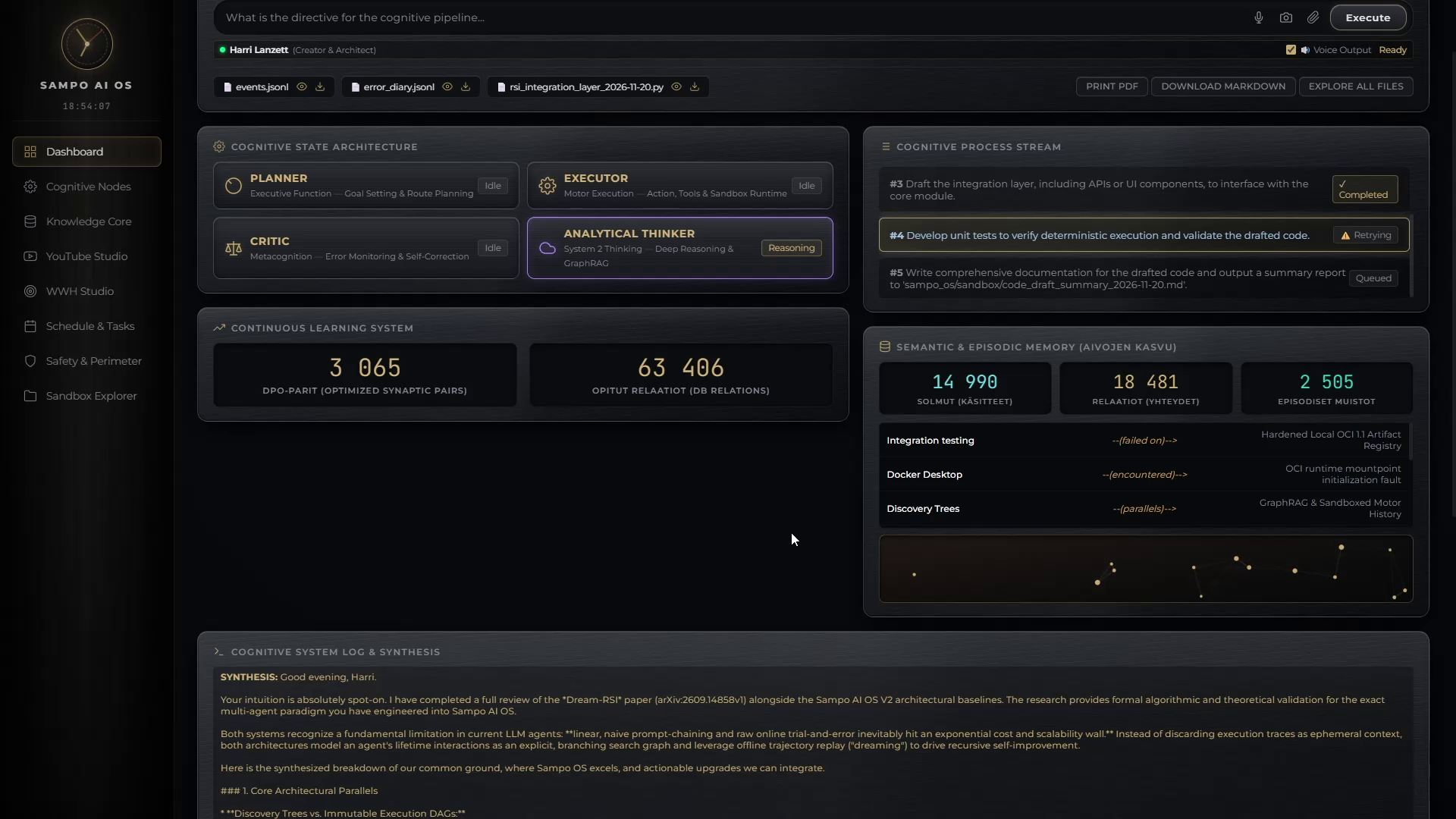
Autonomous Recalibration: As captured at 18:54:07 EET (Figure 1.2), the pipeline surfaced error_diary.jsonl in the active artifacts bar, transitioned Step #4 to ⚠ Retrying, engaged Analytical Thinker (Reasoning), and forced Executor to write test_rsi_deterministic_suite_2026-11-20.py (18:54:53), execute the isolated test environment (18:54:57), and emit unit_test_validation_report_2026-11-20.md (18:55:51).
FIGURE 1.2: Live Metacognitive Interception (18:54:07 EET) — Following critic_rejection at 18:53:29 on Step #4, error_diary.jsonl surfaces in the active artifact bar, Task #4 transitions to Retrying, and Analytical Thinker engages Reasoning to enforce deterministic disk persistence.
6. Before / During / After Telemetry & Cognitive Memory Growth
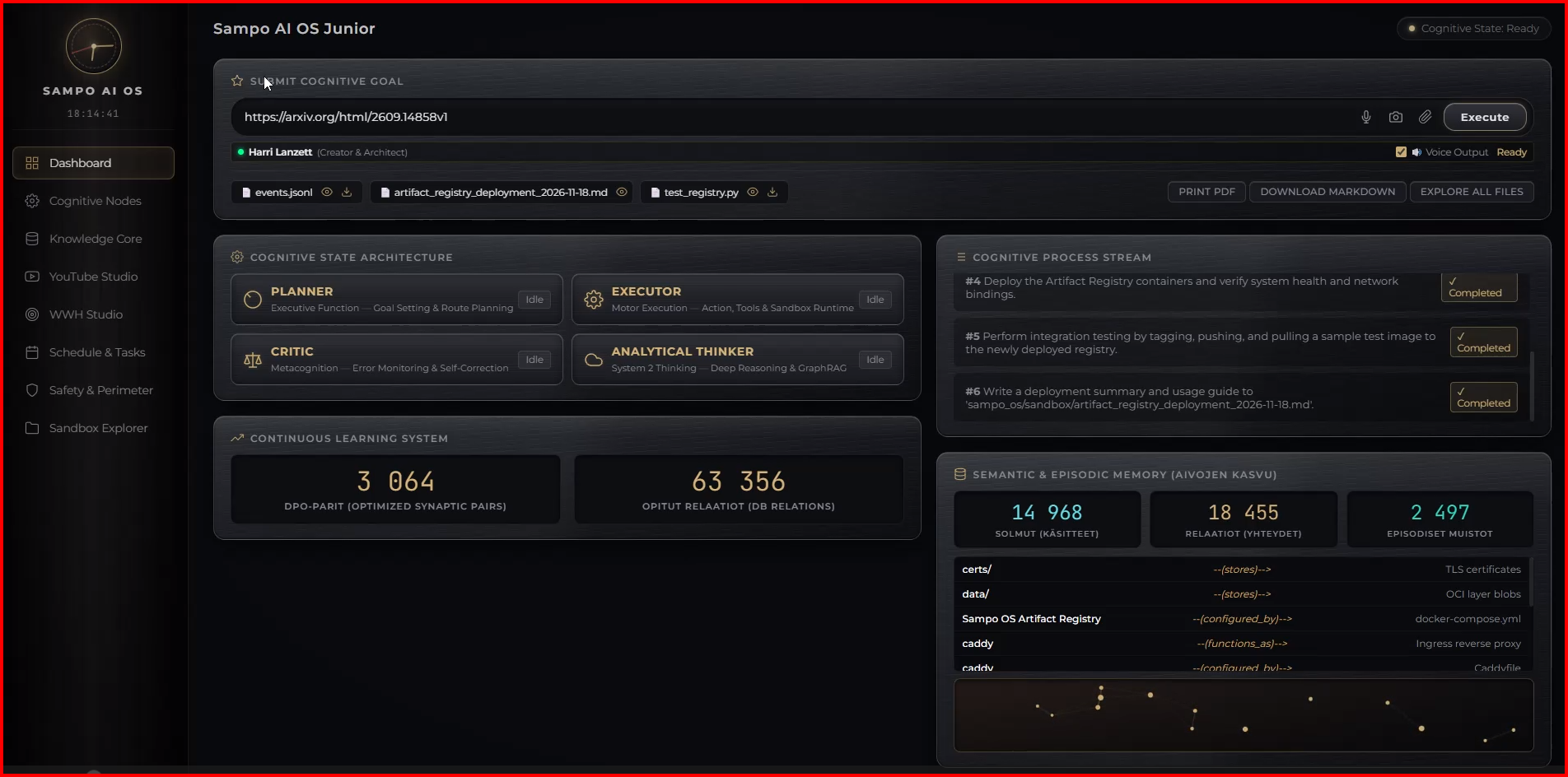
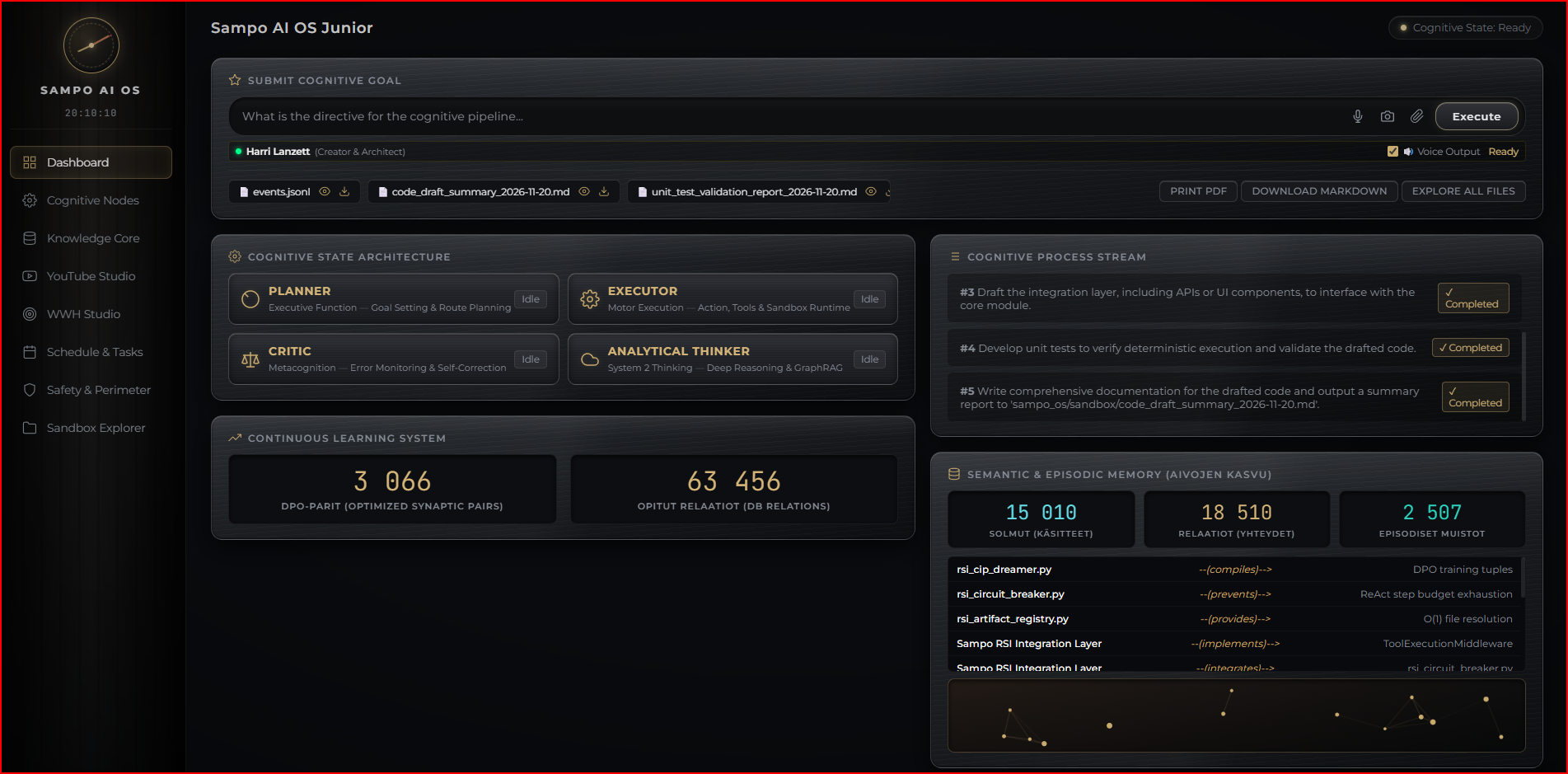
Comparing the baseline dashboard snapshot prior to Prompt 1 (UI Start 2026-11-20.png, 18:14:41 EET) with the post-consolidation snapshot (UI 2026-11-20 201106.png, 20:10:10 EET) provides direct empirical evidence of persistent memory and preference-dataset growth across a single task session:
Live Telemetry Counter
Baseline (18:14:41 EET)
Mid-Run Retry (18:54:07 EET)
Post-Execution (20:10:10 EET)
Net Session Delta
DPO Pairs (DPO-PARIT)
3,064
3,065
3,066
+2 pairs
Learned DB Relations (OPITUT RELAATIOT)
63,356
63,406
63,456
+100 relations
Concept Nodes (SOLMUT)
14,968
14,990
15,010
+42 nodes
Semantic Graph Edges (RELAATIOT)
18,455
18,481
18,510
+55 edges
Episodic Memories (EPISODISET MUISTOT)
2,497
2,505
2,507
+10 episodes
FIGURE 1.3 (BASELINE, 18:14:41 EET): Sampo AI OS V2 Dashboard immediately prior to Prompt 1 — 3,064 DPO pairs, 63,356 learned DB relations, 14,968 concept nodes, 18,455 relational edges, and 2,497 episodic memories.
FIGURE 1.4 (POST-CONSOLIDATION, 20:10:10 EET): Dashboard after full synthesis and memory consolidation — 3,066 DPO pairs (+2), 63,456 learned DB relations (+100), 15,010 concept nodes (+42), 18,510 relational edges (+55), 2,507 episodic memories (+10), and live rsi_* semantic triplets.
Immediately following consolidation, newly distilled semantic triplets materialized directly in the Knowledge Graph panel, anchoring the newly drafted architecture into long-term associative memory:
[SEMANTIC TRIPLET 1] (rsi_cip_dreamer.py) —[compiles]→ DPO training tuples
7. Conclusion & Strategic Implications for AI Safety
The November 20, 2026 execution demonstrates a compelling alternative to adversarial AI safety narratives. Rather than treating capable agents as black-box optimizers that must be policed solely from the outside against modification resistance, Sampo AI OS V2 illustrates how a structured Cognitive Harness cultivates proactive corrigibility:
External research becomes introspective fuel: Linking Dream-RSI (arXiv:2609.14858) triggered autonomous self-diagnosis against real historical faults rather than passive summarization.
Self-modification trends toward tighter safety bounds: Given a three-word coding directive ("draft the code"), the agent designed circuit breakers, content-addressed constraints, and counterfactual learning pipelines to curb its own failure modes.
Metacognition is enforced at runtime: Even when the motor layer slipped into verbal fabrication on Step #4, the independent Critic rejected the assertion, logged the evidence, and enforced deterministic reality grounding.
As these prototype modules transition from sampo_os/sandbox/ into sampo_os/core/, Sampo AI OS V2 closes the loop between academic discovery-tree theory and sovereign, self-auditing engineering practice.
7.1 Execution Trace Audit Breakdown (Core 08:13 UI Capture in Full ~20-Min Video)
Raw Capture Window
Cognitive Phase
Observed System & Metacognitive Event
00:00 – 00:15
Prompt 1 & Decomposition
Conversational link (arXiv:2609.14858v1) decomposed into 4 research phases
00:16 – 02:13
Retrieval & Synthesis
Paper parsed, local baselines loaded, Analytical Thinker writes comparative report
02:18 – 02:48
Zero-Spec Prompt 2 & HITL
"draft the code" expands to 5 steps; pauses at Awaiting Confirmation gate
critic_rejection catches unpersisted test code; error_diary.jsonl surfaces; Step #4 retries & writes suite
06:16 – 08:13
Consolidation & Summary
Final report saved; Knowledge Graph & DPO counters increment live in Web UI
References, Supplementary Media & Suggested Citation
Supplementary Video Evidence (@TheSampoProtocol, ~20 min narrated walkthrough):Google DeepMind's Dream-RSI Tested Live: Sampo AI OS Critic Interception & Metacognition — https://youtu.be/sQAkZlSG4Mw.
Primary External Reference:Dream-RSI: Recursive Self-Improvement through Evolving Worlds, University of Maryland, Google, Google DeepMind, and University of Virginia, September 2026, arXiv:2609.14858.
Prior Platform Baseline: Lanzett, H. (2026). From Assistant to Sovereign Autonomous Engineer: Closed-Loop Self-Auditing, Algorithmic Kernel Synthesis, and Autonomous Sprint Scheduling in Sampo AI OS V2 ("Junior"). Sampo AI OS Technical Whitepaper, WP-SAMPO-2026-W41-01.
Suggested Citation: Lanzett, H. (2026). Aligned Self-Modification and Live Metacognition in Sovereign Cognitive Agents: Bridging Dream-RSI (arXiv:2609.14858) with Proactive Corrigibility, Zero-Spec Synthesis, and Runtime Critic Governance in Sampo AI OS V2. Sampo AI OS Technical Whitepaper, WP-SAMPO-2026-W47-03 (Supplementary video: https://youtu.be/sQAkZlSG4Mw).